

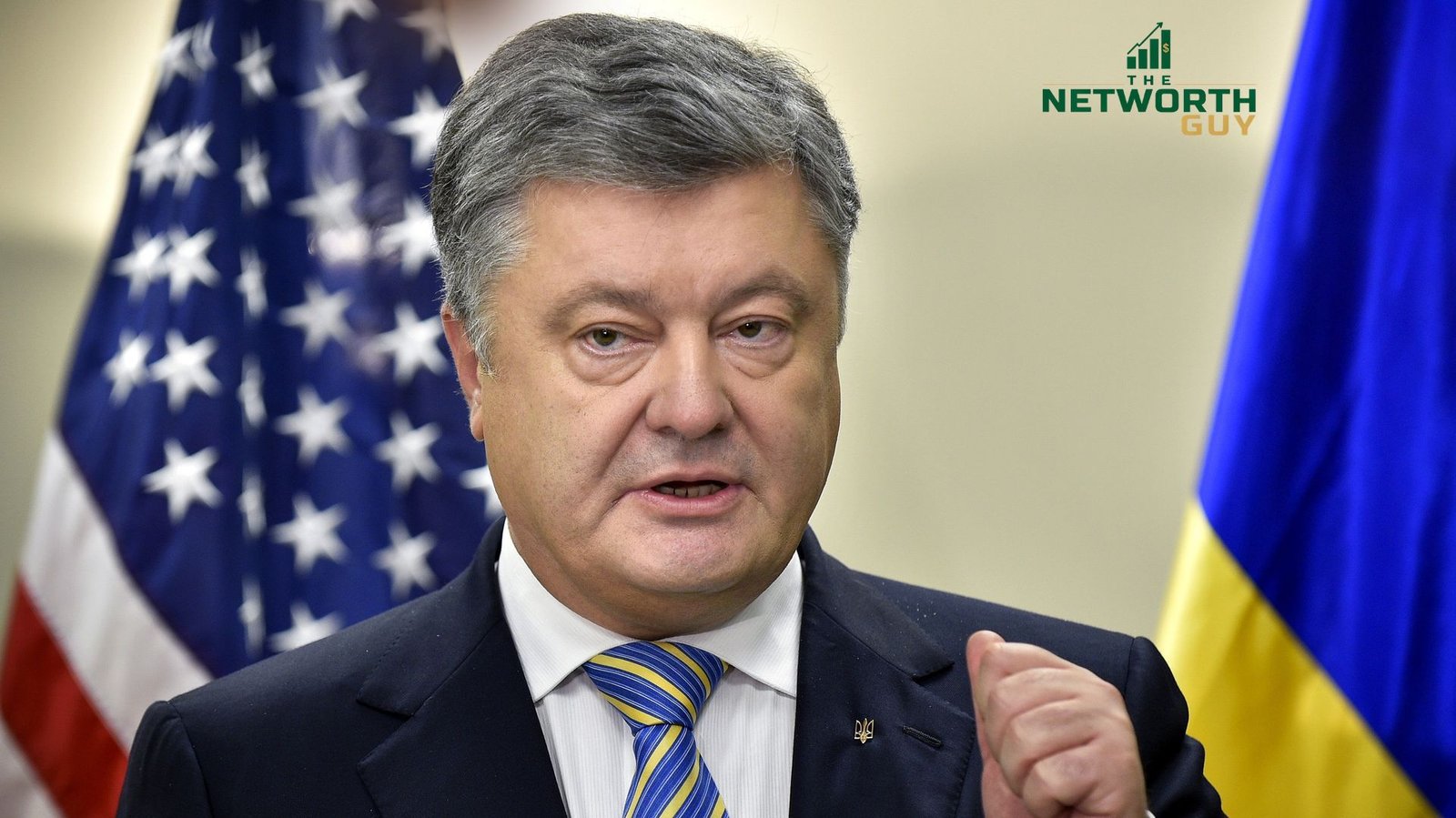
What Is Petro Poroshenko’s Net Worth?
Petro Poroshenko’s net worth is estimated at approximately $1.2 billion in 2026, according to Forbes’ latest available real-time estimate. That makes him one of Ukraine’s wealthiest businesspeople and keeps him within the global billionaire class.
His fortune was not built primarily through politics. Poroshenko made his money in business, especially through the confectionery industry and the development of the Roshen group. Forbes says he began by selling cocoa beans before acquiring confectionery plants and bringing them together under Roshen.
The important point for readers researching poroshenko net worth is that billionaire estimates are not the same as cash in a bank account. They attempt to measure the value of businesses, investments, property and other assets after considering available liabilities and market conditions.
That distinction matters particularly in Poroshenko’s case because his business interests have changed substantially over time, while some assets have been placed under trust arrangements or affected by political and geopolitical developments.
Quick Facts About Petro Poroshenko
| Fact | Details |
| Full Name | Petro Oleksiyovych Poroshenko |
| Age | 60 |
| Birth Date | September 26, 1965 |
| Birthplace | Bolhrad, Ukrainian SSR |
| Nationality | Ukrainian |
| Profession | Businessman, politician, former president |
| Estimated Net Worth | $1.2 billion (2026) |
| Marital Status | Married |
| Children | 4 |
| Known For | Roshen, Ukrainian politics, presidency |
| Nickname | “Chocolate King” |
Net-worth figures for private individuals are estimates and can differ by methodology and valuation date. Forbes lists Poroshenko at $1.2 billion as of July 28, 2026.
Why Do Poroshenko’s Net Worth Estimates Differ?
There is no single universally reported figure.
Forbes currently reports $1.2 billion, while GoodReturns lists approximately $1.26 billion, Iconic Billionaires reports $1.2 billion, and Celebrity Net Worth lists $1.6 billion.
These differences can result from:
- Different valuation dates
- Different assumptions about private companies
- Changes in currency and asset values
- Different treatment of trusts and ownership interests
- Different estimates of private investments and liabilities
For that reason, $1.2 billion is the best headline estimate for 2026, while the broader range demonstrates why net-worth reporting should be treated as an estimate rather than an audited personal balance sheet.
Petro Poroshenko Net Worth and Income Sources
Poroshenko’s wealth is fundamentally a business fortune, rather than a presidential salary fortune.
1. Roshen and Confectionery
The biggest part of Poroshenko’s wealth story is Roshen, the Ukrainian confectionery group that became synonymous with his public image as the country’s “Chocolate King.”
Forbes reports that Roshen sells chocolates, caramel, wafers, cakes and other confectionery products across about 35 countries and estimates annual sales at roughly $800 million.
Poroshenko began in the cocoa trade and subsequently acquired confectionery plants. Those businesses were consolidated into Roshen, turning a relatively traditional food business into an international confectionery operation.
This is the central engine behind his billionaire status.
2. Agricultural and Food Businesses
Beyond sweets, the wider business network associated with Poroshenko has included agricultural and food-processing interests.
Companies connected with the broader UkrPromInvest business network have included food producers and agricultural operations. Ukrainian corporate data also shows substantial revenues and assets among companies connected to the wider business group.
These interests demonstrate that his wealth has never depended entirely on one chocolate brand.
3. Media Assets
Media has also played a role in Poroshenko’s business profile.
He has long been associated with 5 Kanal, a Ukrainian television channel. Unlike several other assets, the channel was specifically treated differently when Poroshenko discussed selling his business interests after becoming president.
Media ownership can be financially valuable, but its significance in Poroshenko’s overall net worth is generally smaller than his major business holdings.
4. Automotive and Industrial Businesses
Poroshenko’s earlier business empire extended into automotive manufacturing and industrial companies.
UkrPromInvest was involved with automobile and bus factories, while the broader group also had interests connected to shipbuilding. The Bogdan automotive interests were later separated, and Poroshenko sold his stake in the Bogdan corporation in 2009.
5. Shipbuilding
The Kuznia na Rybalskomu shipyard in Kyiv was another important industrial asset associated with Poroshenko’s business network.
The shipyard illustrates how his original fortune expanded beyond food production into heavy industry and manufacturing. His wider business interests historically included the Sevastopol shipyard as well, although that asset was later lost following Russia’s annexation of Crimea.
6. Banking and Investments
Poroshenko has also been associated with financial investments, including International Investment Bank and investment-management structures.
His financial interests are one reason a simple calculation based only on Roshen does not fully explain his wealth.
7. Political Salary
Poroshenko has earned income from public office, including serving as a member of parliament, foreign minister, economic development and trade minister, and president.
However, these salaries do not explain his billionaire fortune. His wealth was established through decades of private-sector activity before and alongside his political career.
What About Acting, Music and Brand Endorsements?
Unlike entertainment celebrities, Poroshenko does not have meaningful reported income from acting, music royalties or conventional celebrity endorsements.
His financial profile is better understood through business ownership, private investments, corporate assets, agriculture, confectionery and media interests.
Early Life and Education
Petro Oleksiyovych Poroshenko was born on September 26, 1965, in Bolhrad, in what was then the Ukrainian SSR.
He later built his personal and professional base around Kyiv and Vinnytsia. He studied economics and international economic relations at Taras Shevchenko National University of Kyiv, graduating before entering the business world.
His education was particularly relevant to the career that followed because Poroshenko initially focused on international trade and commercial activity rather than entering politics immediately.
Petro Poroshenko’s Career Journey
1980s–Early 1990s: Entering Business
Poroshenko began his commercial career around international trade, including cocoa beans.
This experience gave him a foundation in commodity trading and helped establish the business relationships that eventually led him into confectionery manufacturing.
1993: UkrPromInvest
In 1993, Poroshenko, his father Oleksii and business associates created UkrPromInvest, an industrial and investment company. Its interests eventually expanded across confectionery, automobiles, agriculture and other industries.
1995–1996: Roshen Takes Shape
Poroshenko acquired control of several confectionery companies and consolidated them into what became Roshen.
This was the pivotal business period in his wealth creation. The company eventually developed into one of Ukraine’s best-known confectionery producers.
1998: Entering Parliament
Poroshenko entered Ukrainian national politics as a member of parliament.
Rather than abandoning business completely, he continued to be associated with a growing network of commercial assets while building his political career.
2005: National Security and Defense Council
He became secretary of Ukraine’s National Security and Defense Council during the presidency of Viktor Yushchenko.
2009–2010: Foreign Minister
Poroshenko served as Ukraine’s foreign minister from 2009 to 2010. His political profile increasingly moved from domestic business and parliament toward international diplomacy.
2012: Minister of Economic Development and Trade
Under President Viktor Yanukovych, Poroshenko became minister of economic development and trade in 2012.
He later returned to parliament.
2014: Becomes President of Ukraine
Following the Euromaidan revolution and political upheaval in Ukraine, Poroshenko ran for president.
He won the May 2014 presidential election in the first round with roughly 55% of the vote, giving him a strong electoral mandate.
He served as Ukraine’s fifth president from 2014 until 2019.
2014–2019: Presidency and Business Separation
Poroshenko said he would sell his principal business interests after taking office. He hired Rothschild to help with the proposed sale of Roshen, while Channel 5 was treated as an exception.
His business assets were subsequently placed into trust-management arrangements. Reports have described the Roshen interest as being transferred to a blind trust, with Rothschild involved in the structure.
2019: Loses Presidential Election
Poroshenko sought a second presidential term in 2019 but lost the runoff to Volodymyr Zelenskyy.
Zelenskyy won approximately 75% of the second-round vote compared with about 25% for Poroshenko.
2019–2026: Return to Opposition Politics
After leaving the presidency, Poroshenko remained active in Ukrainian politics and continued serving as a member of parliament.
His wealth story also continued to evolve as business valuations, geopolitical conditions and legal restrictions affected the value and accessibility of assets.
Major Achievements
Poroshenko’s career combines major achievements in both business and government.
Business Achievements
- Built a major Ukrainian confectionery business through Roshen.
- Expanded into agriculture, manufacturing, media and financial investments.
- Helped build UkrPromInvest into a diversified business network.
- Became one of Ukraine’s best-known billionaire entrepreneurs.
Political Achievements
- Served as Ukraine’s fifth president.
- Served as foreign minister.
- Served as minister of economic development and trade.
- Served in the Verkhovna Rada.
- Led Ukraine during a critical phase of the Donbas conflict.
- Pursued closer integration between Ukraine and the European Union.
During his presidency, Ukraine signed the EU-Ukraine Association Agreement and moved toward visa-free travel with the European Union.
Petro Poroshenko’s Assets and Lifestyle
Poroshenko’s wealth has historically included a mixture of corporate interests, investment structures, property and other assets.
His lifestyle has attracted attention because of his billionaire status, but his financial story is more complicated than a list of luxury purchases.
Investigations by the Organized Crime and Corruption Reporting Project have examined offshore companies linked to Poroshenko and his business structures. OCCRP reported that several offshore entities were used in connection with business and asset transactions, while Poroshenko’s representatives have said offshore structures were part of efforts to restructure assets and place Roshen into a trust.
These reports should not be interpreted as proof that every offshore structure represented illicit wealth. Offshore companies can have legitimate corporate and tax-planning purposes, although their use by a sitting president naturally generated significant public scrutiny.
Poroshenko’s Business Empire: What Happened to Roshen?
Roshen remains the most important name in the Poroshenko wealth story.
However, the company’s history has been affected by geopolitical events.
Russia’s restrictions on Roshen products hurt the company, while the war in Ukraine created further operational challenges. Forbes notes that Poroshenko’s net worth fell by more than half after Russia’s invasion of Ukraine as Roshen faced factory disruptions.
That provides an important explanation for why Poroshenko’s wealth has not simply increased every year.
His fortune is closely connected to the performance and valuation of private businesses operating in a country affected by war, currency pressure and political risk.
Petro Poroshenko Net Worth Growth Timeline
| Year | Estimated Net Worth | Key Wealth Factor |
| 2012 | ~$1.0 billion | Forbes billionaire ranking |
| 2013 | ~$1.6 billion | Strong business valuations |
| 2014 | ~$1.3 billion | Presidential campaign and economic turmoil |
| 2015 | ~$720 million | Roshen pressure and Ukrainian economic weakness |
| 2016 | ~$858 million | Business and asset repricing |
| 2019 | Around $1 billion | Political transition and changing asset values |
| 2025 | ~$1.8 billion | Stronger billionaire valuation estimates |
| 2026 | $1.2 billion | Current Forbes real-time estimate |
Historical billionaire estimates vary considerably between publications and dates. For example, available sources put his wealth at $1 billion in 2012, around $720 million in 2015, and $858 million in 2016. Forbes’ current figure is $1.2 billion in July 2026.
The table should therefore be viewed as a historical estimate timeline, not an audited statement of Poroshenko’s personal balance sheet.
Why Did Petro Poroshenko’s Wealth Fall?
There are several reasons his net worth has moved sharply over the years.
First, his fortune depends heavily on private companies whose values can change quickly.
Second, Roshen has faced serious geopolitical disruption. Russia previously restricted Roshen products, and the broader war in Ukraine created additional operational and valuation pressure.
Third, political risk matters. Poroshenko’s status as both a billionaire and a senior political figure means his assets have faced unusually high levels of scrutiny.
In February 2025, Ukraine imposed sanctions on Poroshenko. He disputed the decision and said it affected his accounts and assets. Reuters reported the sanctions while noting the political dispute surrounding them.
This is an important part of understanding his current wealth: net worth is not necessarily the same thing as immediately accessible wealth.
Personal Life
Petro Poroshenko is married to Maryna Poroshenko, and they have four children.
His family has also been involved in Ukrainian public life. His son Oleksii Poroshenko served as a member of Ukraine’s parliament, while Maryna has been involved in public and social initiatives.
Poroshenko’s family background is therefore closely connected to both his business history and his political career.
Interesting Facts About Petro Poroshenko
- Poroshenko is widely known as Ukraine’s “Chocolate King.”
- His fortune began with cocoa trading before moving into confectionery manufacturing.
- Roshen became the centerpiece of his business empire.
- He served as both foreign minister and economic development and trade minister.
- He became president of Ukraine in 2014 after winning the election in the first round.
- He lost the 2019 presidential runoff to Volodymyr Zelenskyy.
- His businesses have historically covered food, agriculture, automobiles, shipbuilding, finance and media.
- Forbes currently estimates his wealth at $1.2 billion in 2026.
- His wealth has experienced major fluctuations because of geopolitical and economic conditions.
- He remained active in Ukrainian politics after leaving the presidency.
FAQs About Petro Poroshenko Net Worth
What is Petro Poroshenko’s net worth in 2026?
Petro Poroshenko’s estimated net worth is $1.2 billion in 2026, according to Forbes’ real-time billionaire profile dated July 28, 2026.
How did Petro Poroshenko become rich?
He built his fortune primarily through business, beginning with cocoa trading and later acquiring confectionery companies that became the Roshen group. His wider business interests have included agriculture, manufacturing, media and finance.
Is Petro Poroshenko still a billionaire?
Yes. Forbes’ July 2026 real-time estimate places his wealth at approximately $1.2 billion.
Does Petro Poroshenko still own Roshen?
Poroshenko’s relationship with Roshen has been structured through trust arrangements, particularly after he became president. He had announced plans to sell the company and hired Rothschild to assist with the process.
What company made Petro Poroshenko famous?
Roshen made Poroshenko internationally famous as a businessman and earned him the nickname “Chocolate King.”
What businesses has Petro Poroshenko owned?
His business network has included confectionery, agriculture, automobiles, shipbuilding, television and financial investments. Some historical holdings were sold, separated or placed into trust structures.
How old is Petro Poroshenko?
Petro Poroshenko was born September 26, 1965, making him 60 years old as of August 2026.
How many children does Petro Poroshenko have?
Petro Poroshenko and his wife Maryna have four children.
What was Petro Poroshenko’s net worth before becoming president?
Historical estimates varied. Around the time of his 2014 presidential campaign, reports commonly valued his fortune in the billion-dollar range, with estimates around $1.3 billion to $2 billion depending on the source and methodology.
Why is Petro Poroshenko’s net worth different across websites?
Different websites use different valuation dates and methodologies. Forbes currently reports $1.2 billion, while other databases publish higher or slightly different estimates. Private-company valuations, trusts, investments and geopolitical developments make an exact figure difficult to establish.
Did Petro Poroshenko make his money from politics?
No. His billionaire fortune was established primarily through business, especially confectionery and Roshen, before he became president.
What is Petro Poroshenko’s biggest source of wealth?
Confectionery and business holdings connected to Roshen are the central source associated with his fortune. Forbes identifies confectionery as his source of wealth.
How rich is Poroshenko?
Petro Poroshenko is estimated to be worth about $1.2 billion in 2026, according to Forbes.
His fortune was built primarily through Roshen and other business investments.
He remains one of Ukraine’s wealthiest businessmen.
Who is the richest in Ukraine?
Rinat Akhmetov is currently the richest person in Ukraine, with an estimated $7.8 billion fortune in Forbes’ 2026 ranking.
His wealth primarily comes from steel, coal, energy and industrial investments.
He is substantially wealthier than Petro Poroshenko.
Where is Poroshenko now?
Petro Poroshenko remains active in Ukrainian politics and leads the European Solidarity party in the Verkhovna Rada.
He has continued to speak publicly about Ukraine’s war and its European integration.
His political activities remain centered on Ukraine.
How many Ukrainian billionaires are there?
Forbes’ 2026 billionaire ranking includes seven Ukrainians among the world’s billionaires.
Rinat Akhmetov ranks first among them, followed by figures including Victor Pinchuk and Petro Poroshenko.
Their fortunes come from industries such as steel, energy, investments, technology and confectionery.
Who is the No. 1 richest person in Russia?
Alexei Mordashov is the richest Russian on Forbes’ 2026 annual billionaire list, with an estimated fortune of about $39 billion.
He built his wealth primarily through steel and investments.
His ranking can fluctuate with changing market valuations and Forbes’ real-time estimates.
Final Verdict: Petro Poroshenko’s Net Worth in 2026
Petro Poroshenko’s net worth is approximately $1.2 billion in 2026, according to Forbes. His fortune represents decades of business activity rather than income from political office.
The Roshen confectionery empire remains the defining element of his wealth story, but his broader financial history includes agriculture, manufacturing, shipbuilding, media and financial investments.
His wealth has also been unusually volatile. Economic crises, Russia’s restrictions on Roshen, the war in Ukraine, changes in private-company valuations and political developments have all influenced the value and accessibility of his assets.
For readers searching poroshenko net worth, the most useful conclusion is therefore not simply the $1.2 billion headline figure. It is that Poroshenko’s fortune is a diversified but politically exposed business fortune whose estimated value has changed substantially over the past decade.
