

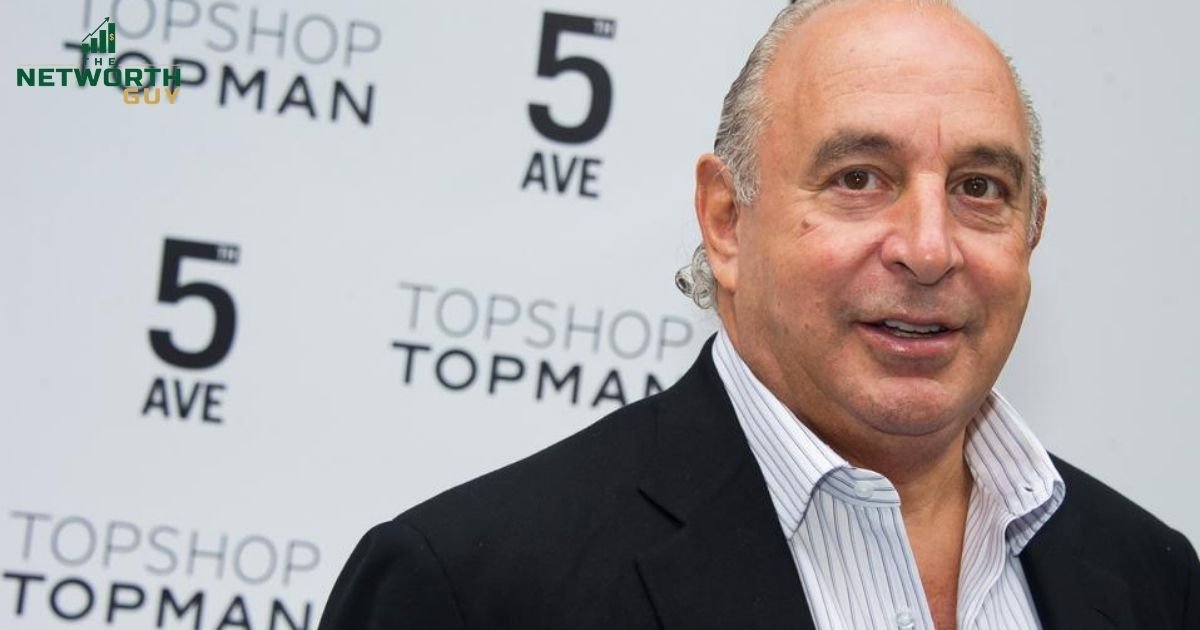
Philip Green net worth is estimated at approximately $1.4 billion as of August 31, 2026, according to Forbes. Green built his fortune primarily through fashion retail, business acquisitions, and his long association with the Arcadia retail empire, which once owned major British brands including Topshop, Topman, Miss Selfridge, Dorothy Perkins and Burton.
Once known as the “King of the High Street,” Sir Philip Green became one of Britain’s most prominent retail billionaires. However, his financial story has also been shaped by the decline of traditional high-street shopping, the collapse of BHS, and Arcadia Group’s administration in 2020.
Today, Green remains a billionaire according to Forbes, but his fortune is significantly lower than it was during the peak years of his retail empire.
Quick Facts About Philip Green
| Fact | Details |
| Full Name | Sir Philip Nigel Ross Green |
| Date of Birth | March 15, 1952 |
| Age | 74 |
| Birthplace | Croydon, England |
| Nationality | British |
| Occupation | Businessman and Retail Entrepreneur |
| Estimated Net Worth | $1.4 billion |
| Primary Source of Wealth | Fashion retail and business investments |
| Best Known For | Arcadia Group and Topshop |
| Wife | Cristina “Tina” Green |
| Children | Two |
| Notable Asset | Lionheart superyacht |
| Former Major Business | Arcadia Group |
What Is Philip Green’s Net Worth?
Philip Green’s net worth is estimated at $1.4 billion as of August 31, 2026, according to Forbes. Forbes lists Green as a self-made billionaire whose primary source of wealth is fashion retail.
However, estimating Philip Green’s wealth requires some context.
Much of the Green family’s business empire was structured through companies and holdings associated with his wife, Cristina Green. As a result, different publications sometimes report individual wealth, combined family wealth, or historical estimates based on the value of Arcadia and other assets.
For example, the Sunday Times Rich List estimate cited in more recent reporting placed Philip and Tina Green’s combined wealth at approximately £910 million in 2023.
For readers searching for the simplest answer: Forbes currently estimates Philip Green’s personal fortune at approximately $1.4 billion.
Philip Green Net Worth
Philip Green’s fortune was built primarily through fashion retail acquisitions, business restructuring, brand ownership and investment holdings.
His wealth increased dramatically during the growth of Arcadia Group, which became one of Britain’s largest high-street fashion empires.
At its peak, Arcadia owned brands including:
- Topshop
- Topman
- Dorothy Perkins
- Miss Selfridge
- Burton
- Wallis
- Evans
- Outfit
The value of these brands, together with Green’s wider investments and private assets, helped establish him as one of Britain’s richest businessmen.
However, the decline of physical retail and the growth of online shopping placed increasing pressure on the group. Arcadia ultimately entered administration in 2020, and several of its best-known brands were subsequently sold.
Philip Green Income Sources
Philip Green’s wealth has historically come from several interconnected sources.
Fashion Retail
Fashion retail was the foundation of Green’s fortune.
He entered the clothing trade at a young age and developed experience buying, importing and selling fashion merchandise. This practical experience later helped him build a career around acquiring established retail businesses.
Unlike many modern billionaires who created technology companies, Green built his fortune through traditional retail, acquisitions and corporate turnarounds.
Arcadia Group
Arcadia Group became the most important business associated with Philip Green’s wealth.
Green acquired Arcadia in 2002 for approximately £840 million. The company was subsequently taken private and became the centre of the Green family’s fashion retail empire.
During its strongest years, Arcadia controlled thousands of retail locations and operated some of Britain’s most recognizable high-street fashion brands.
The group was particularly successful during the 2000s, when Topshop developed into an internationally recognized fashion brand.
Corporate Dividends
One of the most significant events in the Green family’s financial history was the £1.2 billion dividend paid from Arcadia in 2005.
The dividend became one of the most widely discussed corporate payouts in British business history and played a major role in building the family’s long-term wealth.
Because of the ownership structure surrounding the business, the payment was associated with Tina Green as the shareholder. This is one reason why estimates of Philip Green’s personal wealth and the Green family’s combined wealth can differ.
BHS
Philip Green purchased British Home Stores, commonly known as BHS, for approximately £200 million in 2000.
BHS became part of Green’s wider retail empire and initially contributed to his position as one of Britain’s most powerful high-street businessmen.
However, the company later became the source of major controversy after entering administration in 2016.
The collapse placed thousands of jobs at risk and created serious concerns about the company’s pension arrangements. The issue led to a major parliamentary investigation and became one of the defining controversies of Green’s career.
Business Acquisitions and Investments
A major part of Philip Green’s business strategy involved acquiring established companies.
Over the course of his career, he became associated with businesses and transactions involving:
- Amber Day
- Sears
- BHS
- Arcadia Group
- Topshop
- Topman
- Marks & Spencer
Green was particularly known for identifying large retail businesses that he believed could be acquired, restructured or operated more profitably.
His high-profile attempts to acquire Marks & Spencer also helped establish his reputation as one of Britain’s most aggressive retail dealmakers.
Early Life and Education
Sir Philip Nigel Ross Green was born on March 15, 1952, in Croydon, England.
Green entered the business world at a relatively young age and developed his career through hands-on experience in the clothing trade.
Rather than following a traditional university path into business, Green built practical experience through fashion and retail trading.
That early exposure to the buying and selling of merchandise would eventually become the foundation of his business career.
His later success demonstrated a pattern that would define much of his professional life: identifying commercial opportunities, acquiring established businesses and attempting to improve their financial performance.
Philip Green Career Journey
Philip Green Career Timeline
| Year | Career Milestone |
| 1952 | Born in Croydon, England |
| 1960s–1970s | Began developing experience in the clothing trade |
| 1988 | Became chairman and chief executive of Amber Day |
| 1992 | Left Amber Day |
| 1999 | Acquired Sears |
| 2000 | Purchased BHS for approximately £200 million |
| 2002 | Acquired Arcadia Group for approximately £840 million |
| 2004 | Made a high-profile attempt to acquire Marks & Spencer |
| 2005 | Arcadia ownership structure received a £1.2 billion dividend |
| 2006 | Received a knighthood for services to retail |
| 2016 | BHS entered administration |
| 2020 | Arcadia Group entered administration |
| 2021 | Major Arcadia brands were acquired by new owners |
| 2026 | Forbes estimates Green’s net worth at approximately $1.4 billion |
Early Business Career
Philip Green’s early career was rooted in the fashion trade.
He developed commercial experience by working with clothing and merchandise, learning how to source products and identify opportunities within the retail market.
This experience eventually led him into larger corporate transactions.
Amber Day
Green became chairman and chief executive of Amber Day in 1988.
The role provided him with experience running a publicly traded retail business.
His time at the company ended in 1992, but the experience contributed to his development as a businessman and corporate dealmaker.
Acquiring Major Retail Businesses
Green’s career reached another level during the late 1990s and early 2000s.
He acquired Sears in 1999 before purchasing BHS in 2000.
His acquisition of Arcadia Group in 2002 proved even more important. Arcadia would eventually become the centre of his family’s retail empire and the main source of the public perception of Philip Green as Britain’s “King of the High Street.”
Major Achievements
Built a Major British Retail Empire
Philip Green helped build one of the most recognizable retail groups in the United Kingdom.
At its peak, Arcadia controlled a collection of major fashion brands and operated thousands of stores and concessions.
The group’s brands became fixtures of British high-street shopping for decades.
Turned Topshop Into an International Fashion Brand
Topshop became one of Arcadia’s most valuable and recognizable brands.
The company developed a significant international profile and became closely associated with British high-street fashion.
Topshop’s success was a major contributor to the prominence of the Green family’s retail empire.
Completed Major Retail Acquisitions
Green became one of Britain’s best-known retail dealmakers through major acquisitions involving companies such as BHS and Arcadia.
His acquisition strategy was central to the growth of his fortune.
Achieved Billionaire Status
Philip Green became one of the United Kingdom’s most prominent self-made billionaires.
Despite the collapse of Arcadia and the decline of his traditional retail empire, Forbes continues to list him as a billionaire, with a real-time net worth of approximately $1.4 billion as of August 31, 2026.
Philip Green Assets and Lifestyle
Philip Green has long been associated with a highly luxurious lifestyle.
His family has owned or been associated with expensive yachts, real estate and private aviation.
However, it is important to distinguish between publicly reported assets and confirmed personal ownership. Many assets connected with the Green family have historically been held through private companies or ownership structures associated with Tina Green.
Lionheart Superyacht
The most famous luxury asset associated with Philip Green and his family is the 90-metre Lionheart superyacht.
Lionheart was commissioned by the Green family and built by Italian yacht manufacturer Benetti. It was completed in 2016 and became one of the most recognizable symbols of the family’s wealth and lifestyle.
The yacht has been widely associated with Philip and Tina Green, although the exact legal ownership structure of private assets may differ from public descriptions.
Other Yachts
Forbes has reported that the Green family owns three yachts with a combined reported value of approximately $140 million.
Because yacht ownership and valuations can change over time, such figures should be treated as reported estimates rather than precise current financial values.
Real Estate
The Green family’s wealth has also been associated with high-value real estate.
Forbes has reported nearly $40 million in real estate purchased by Cristina Green through offshore companies.
Private real-estate ownership can change, and current market values may differ significantly from original purchase prices.
Private Aviation
Philip Green has also been publicly associated with private aviation.
However, ownership of aircraft and other luxury assets may change over time, so older reports should not automatically be treated as evidence of current ownership.
For this reason, net-worth calculations should focus on reliable financial estimates rather than simply adding the reported prices of yachts, properties and aircraft.
Philip Green Personal Life
Philip Green is married to Cristina “Tina” Green.
The couple has two children and has long been associated with Monaco and an international lifestyle.
Tina Green has played a significant role in the ownership structure of the family’s business interests and has herself appeared in wealth reporting.
Forbes has described Philip and Cristina Green as the couple behind the former Arcadia retail empire.
Their family and business structure is important when analyzing Philip Green’s net worth because some major assets and companies have historically been associated with Tina Green’s ownership.
Philip Green Net Worth Growth Timeline
Philip Green’s wealth has experienced significant changes throughout his career.
His fortune grew rapidly as his retail acquisitions expanded, reached its strongest period during Arcadia’s success, and later faced substantial pressure as the traditional high-street retail sector declined.
| Period | Wealth Trend | Major Development |
| 1970s–1980s | Building wealth | Developed career in fashion and retail |
| 1990s | Significant growth | Expanded through business acquisitions |
| Early 2000s | Rapid growth | Acquired BHS and Arcadia |
| Mid-2000s | Peak wealth-building period | Arcadia expanded and generated major dividends |
| Late 2000s | Billionaire status | Became one of Britain’s richest businessmen |
| 2010s | Wealth faced pressure | High-street retail faced increased competition |
| 2016 | Reputation and financial pressure | BHS entered administration |
| 2020 | Major business setback | Arcadia entered administration |
| 2023 | Combined family estimates declined | Sunday Times Rich List estimate cited at approximately £910 million |
| 2026 | Billionaire status maintained | Forbes estimates Philip Green’s net worth at approximately $1.4 billion |
Private-company structures and family ownership arrangements make it difficult to create an exact audited year-by-year wealth history. These figures should therefore be viewed as an overview of Green’s financial trajectory rather than exact annual balance-sheet calculations.
Interesting Facts About Philip Green
- Philip Green was born in Croydon, England, in 1952.
- He built his career in the fashion and retail industry rather than through technology or finance.
- He became chairman and chief executive of Amber Day in 1988.
- He acquired BHS for approximately £200 million in 2000.
- He acquired Arcadia Group for approximately £840 million in 2002.
- Arcadia once owned Topshop, Topman, Miss Selfridge, Dorothy Perkins, Burton, Wallis and Evans.
- A £1.2 billion dividend associated with Arcadia’s ownership structure became one of the most notable corporate payouts connected with his business empire.
- Green made high-profile attempts to acquire Marks & Spencer.
- BHS entered administration in 2016, leading to major political and public controversy.
- Arcadia entered administration in 2020, after which several major brands were sold.
- He is closely associated with the 90-metre superyacht Lionheart.
- Forbes currently estimates his fortune at approximately $1.4 billion.
Conclusion - Philip Green’s net worth is estimated at approximately $1.4 billion, making him one of the most recognizable former retail billionaires in Britain.
- His fortune was built through decades of fashion retail, business acquisitions and the growth of Arcadia Group. At its height, Arcadia controlled some of Britain’s most famous high-street brands and helped establish Green as one of the country’s wealthiest businessmen.
- The later collapse of BHS and Arcadia dramatically changed the public and financial story surrounding his business empire. Nevertheless, Forbes continues to list Philip Green as a billionaire, illustrating how significant private wealth and investments can remain even after the decline of a company’s most visible operating businesses.
Frequently Asked Questions
What is Philip Green’s net worth?
Philip Green’s net worth is approximately $1.4 billion as of August 31, 2026, according to Forbes’ real-time billionaire estimate.
Is Philip Green still a billionaire?
Yes. Forbes currently lists Philip Green as a billionaire with an estimated net worth of approximately $1.4 billion.
How did Philip Green make his money?
Philip Green made his money primarily through fashion retail, business acquisitions, retail restructuring and investments. His most important business association was with Arcadia Group.
What company made Philip Green rich?
Arcadia Group was the company most closely associated with Philip Green’s billionaire fortune. The group owned brands including Topshop, Topman and Dorothy Perkins.
Did Philip Green own Topshop?
Philip Green and his family’s retail empire controlled Topshop through Arcadia Group until Arcadia entered administration in 2020.
What happened to Arcadia Group?
Arcadia Group entered administration in 2020. Several of its best-known brands were subsequently sold to new owners.
How much did Philip Green pay for BHS?
Philip Green acquired BHS for approximately £200 million in 2000.
Why did BHS collapse become controversial?
The collapse of BHS became controversial because of concerns about the company’s pension deficit and the impact on thousands of workers. The matter was investigated by UK parliamentary committees.
Who is Philip Green’s wife?
Philip Green’s wife is Cristina “Tina” Green, a businesswoman who has played a major role in the ownership structure of the family’s business interests.
How much is Sir Philip Green worth now?
Sir Philip Green’s net worth is estimated at approximately $1.4 billion as of August 31, 2026, according to Forbes. His fortune was primarily built through fashion retail.
Is Philip Green still a billionaire?
Yes, Philip Green is still a billionaire. Forbes currently estimates his wealth at around $1.4 billion, despite the collapse of Arcadia Group.
Is Philip Green still in business?
Philip Green is still associated with private wealth and business interests, but he no longer controls the Arcadia retail empire. Arcadia went bankrupt in 2020, and brands including Topshop and Topman were sold.
What yacht is Philip Green associated with?
Philip Green is closely associated with Lionheart, a 90-metre superyacht commissioned by the Green family.
Does Philip Green still own Arcadia Group?
No. Arcadia entered administration in 2020, and its major brands were subsequently sold to new owners.
Why do different websites report different net-worth figures for Philip Green?
Different estimates may measure Philip Green’s individual wealth, the combined wealth of Philip and Tina Green, historical asset values or different assumptions about private companies and investments. Forbes currently provides a real-time estimate of approximately $1.4 billion for Philip Green.
Suggested Post
- Alessandra Garavoglia Net Worth: Powerful Campari Fortune
- Bill Austin Net Worth: Powerful Rise of Starkey Billionaire

1 thought on “Philip Green Net Worth: How the Arcadia and Topshop Tycoon Built His Fortune”